Waterfall vs Header Bidding: Which is Better for Your Website in 2025?
Not too long ago, web monetization felt pretty straightforward. You'd plug in a few demand partners through Google Ad Manager, stack them in a waterfall based on historical eCPMs, and watch the revenue roll in. And for a while, it did. Operations were manageable. Publishers had control. Life was good.
But things change. The way users browse, the way advertisers buy, and the way yield optimization actually works have all evolved. What made perfect sense in 2019 doesn't quite cut it in 2025.
Today, publishers are dealing with unified auctions, simultaneous bidding, yield optimization algorithms, and an increasing number of demand partners all competing for the same impressions. Somewhere between the promise of pure header bidding and the familiarity of traditional waterfalls, there's a more practical approach that's actually working: the Hybrid setup.
Before we get there, let's step back.
The Traditional Waterfall: Built on Predictability
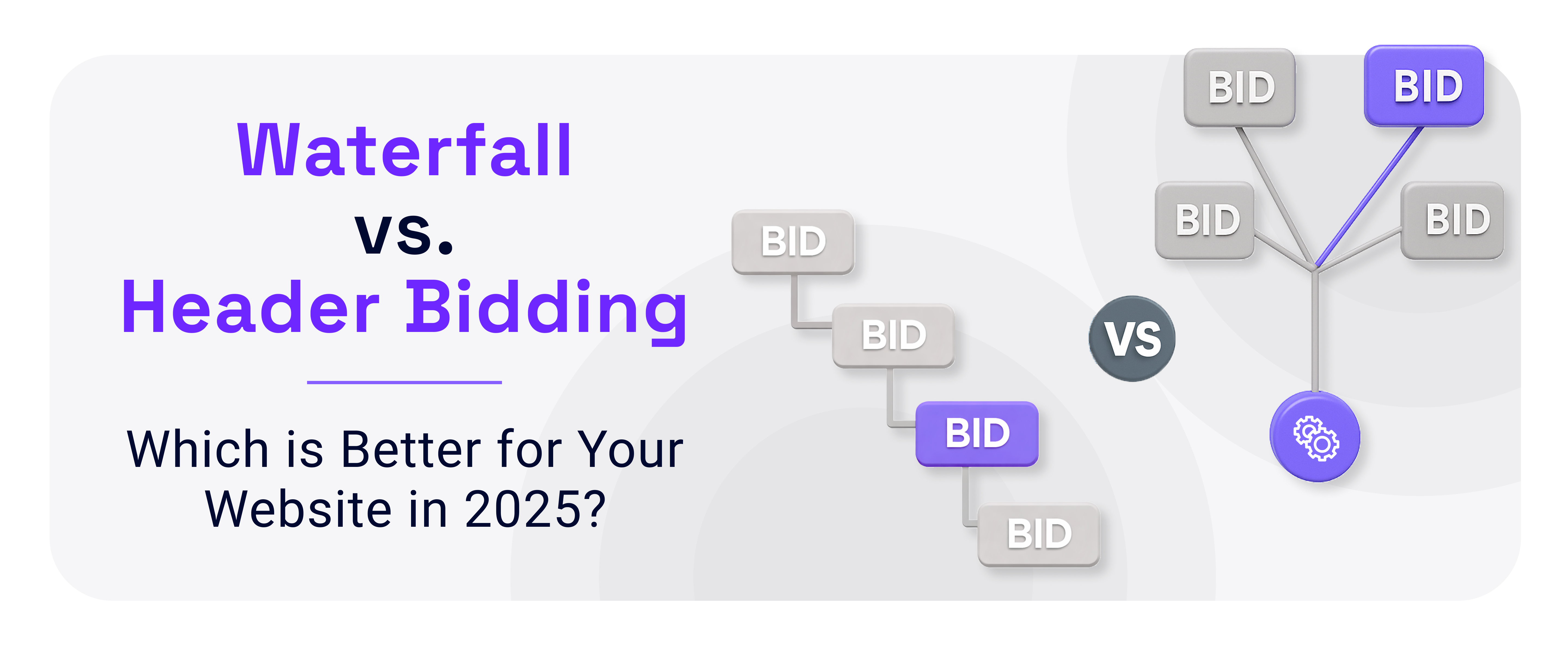
The waterfall model was designed around control. You'd rank your ad networks based on historical eCPM performance, and ad requests would cascade down the list until one network filled the impression. Simple. Predictable. Easy to troubleshoot when things went sideways.
And when your traffic patterns were stable and demand partners behaved consistently, it worked well enough. You knew what to expect. Your operations team could manage it without constantly putting out fires.
But here's the catch: waterfalls make decisions based on yesterday's data. They prioritize networks based on past performance, not what's happening right now. In a world where advertisers adjust budgets by the hour and user value varies wildly by session, that rigidity costs you money.
A network that averaged $3 CPM last week might have a $7 bid ready right now, but if it's sitting at position six in your waterfall, it never even gets the chance to compete.
The Header Bidding Revolution (and Its Reality Check)
Then came header bidding.
The pitch was compelling: let all your demand partners bid at once, in real-time, before the ad server makes a decision. True competition. Better fill rates. Higher CPMs. Less manual tinkering. For many publishers, this looked like the future they'd been waiting for.
And in a lot of cases, the results backed it up. Publishers saw revenue lifts of 20-40% in the first few months. Fill rates improved. The need for constant waterfall adjustments decreased. The industry got excited. Really excited.
But the rollout wasn't all smooth sailing. Some premium demand partners weren't ready to participate in header bidding auctions. Others had timeout issues that dragged down page performance. Certain bidders worked beautifully for US traffic but fell flat internationally. Then there were the technical headaches: wrapper configurations, bid timeouts, latency concerns, and the constant library updates that kept everyone on their toes.
Publishers started noticing something unexpected: when they brought back a few select networks through the traditional waterfall—positioned strategically as backups or for specific inventory types—their overall revenue actually increased. Not just filled better. Made more money. And they regained control over how their premium inventory was valued and sold.
That's when the conversation shifted from "header bidding or waterfall" to something way more practical.
The Hybrid Approach: Practical, Not Revolutionary
Enter the Hybrid setup.
It's not flashy. It won't be the headline at your next ad tech conference. But it works. And it's increasingly what experienced publishers are actually running.
A hybrid setup takes the best of both worlds—the real-time competition of header bidding and the reliable performance of strategic waterfall positioning—and blends them in a way that's flexible and grounded. Your header bidding partners compete in a unified auction for top-tier placements, while carefully selected demand sources hold fallback positions for fill optimization and specific inventory scenarios.
It's adaptive. It's strategic. And most importantly, it reflects how web monetization actually works in 2025. Not in theory, but in practice.
As a Google Certified Publishing Partner (GCPP Premier), we see this playing out across our publisher network consistently. The highest-performing publishers aren't running pure header bidding or traditional waterfalls. They're running intelligent hybrid setups that balance automation with control, competition with reliability. This trend is backed by industry data. According to IAB Europe's 2024 Attitudes to Programmatic Advertising Report, the hybrid operational model—which blends automated bidding with strategic manual controls—remains the most popular approach among publishers and advertisers across Europe. The data shows that sophisticated publishers are moving away from one-size-fits-all solutions toward configurations that balance efficiency with control.
Why does this work? Because it acknowledges a simple truth: not every impression is the same, and not every demand partner performs consistently across all traffic types, geos, and user segments. A hybrid approach gives you the flexibility to optimize for those nuances without forcing an all-or-nothing decision.
We consistently see hybrid setups outperforming both legacy waterfalls and bidding-only experiments. Publishers report better overall yield, reduced timeout issues, more predictable fill rates for lower-tier inventory, and greater control over premium inventory monetization. Plus, when something breaks, it's actually possible to troubleshoot without pulling your hair out.
The Smart Question Isn't "Which One?" It's "How Do I Set This Up Right?"
If you're still asking "Should I switch to header bidding?", you're asking a 2021 question. The better question is: How do I build a hybrid setup that's optimized for my specific inventory, traffic patterns, and monetization goals?
That's where web monetization is actually heading. Not toward one-size-fits-all solutions, but toward configurations that are dynamic, data-informed, and tailored to your actual performance data not someone else's playbook from three years ago.
At YieldSolutions, this is exactly the work we do with publishers every day. Our SmartFloor technology optimizes floor prices in real-time across your hybrid setup. Our HVR (High Value Refresh) system ensures you're not leaving money on the table during viewable impressions. And our SPACE framework gives you the strategic architecture to make hybrid setups work at scale.
The publishers winning in 2025 aren't chasing trends or waiting for the next silver bullet. They're building monetization stacks that actually reflect how their inventory performs in the real world.
And the sooner we stop looking for perfect solutions, the sooner we start building smarter ones.
Want to explore how a hybrid setup could work for your inventory? Schedule a quick conversation with our team.
