The Revenue Gap: 3 Ad Optimization Metrics Publishers Ignore
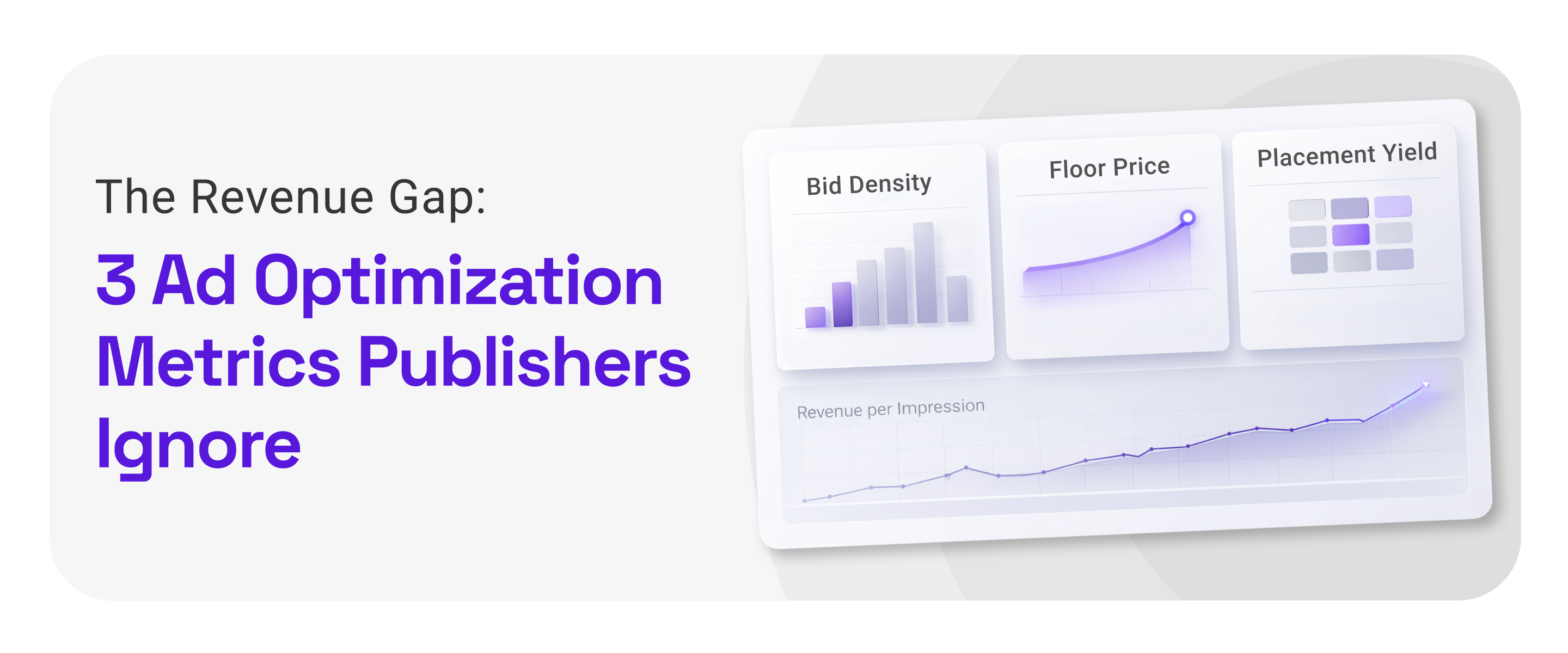
Most publishers track impressions and clicks religiously. But the metrics that predict revenue growth? Those get ignored.
You're monitoring dashboard after dashboard. Impressions are up. Fill rate looks solid. Traffic is climbing. Yet revenue remains flat.
Here's why: the metrics most publishers obsess over are lagging indicators. They tell you what already happened, not what's holding you back. Publishers who consistently grow revenue aren't just tracking different numbers—they're optimizing for entirely different outcomes.
Key Takeaways
- Bid density reveals the real competition for your inventory—more bidders mean higher CPMs
- Floor price efficiency shows whether your pricing strategy is maximizing revenue or leaving money on the table
- Placement yield variance exposes which placements are underperforming
These metrics directly tie to optimization opportunities that AI-powered solutions can address in real-time
Why Traditional Metrics Miss the Mark
Most dashboards show surface-level data: pageviews, ad requests, fill rates, and average CPM. These feel important because they're easy to track.
But they don't tell you why revenue isn't growing.
Two publishers with identical traffic and fill rates can see dramatically different outcomes. The difference? One optimizes for metrics that directly impact advertiser competition and bid values.
1. Bid Density: The Hidden Revenue Multiplier for Publishers
What it measures: The average number of bids received per ad request.
How many demand partners are competing for each impression? Low bids per request means minimal competition. Higher bid counts force demand sources to compete aggressively, driving CPMs up.
Why it matters:
Even if an impression fills, a single bid gives that buyer all the pricing power. Multiple bids create urgency and drive higher CPMs. Publishers using header bidding with proper SSP integration consistently see higher bid density than those relying on waterfalls or limited demand.
How to improve bid density:
- Integrate more quality demand partners through unified header bidding technology
- Reduce auction timeouts that cause programmatic bidders to drop out
- Optimize your ad tech stack to minimize latency that discourages bid participation
- Use server-side header bidding where appropriate to expand demand sources without slowing page load
2. Floor Price Efficiency: Optimizing Your Programmatic Pricing Strategy
What it measures: The percentage of impressions where your floor price is set optimally high enough to capture maximum revenue, but low enough to avoid blocking quality bids.
Static floors are a relic. Yet most publishers still set manual floors and update them quarterly (if that). Meanwhile, demand fluctuates by the hour based on geography, device, time of day, and content category. Static floors can't adapt.
Why it matters:
Floor optimization determines whether you're maximizing revenue per impression or blocking valuable bids. Too low and advertisers win cheap. Too high and you get no bids. Both hurt revenues.
AI-driven floor pricing (like SmartFloor) adjusts dynamically based on real-time demand signals, typically improving revenue by 15-30%.
How to improve floor price efficiency:
- Move away from static floors to dynamic floor pricing with AI optimization
- Segment price floors by device, geography, and content category
- Monitor bid rejection rates to ensure you're not pricing too aggressively in programmatic auctions
- Test floor price adjustments systematically and measure impact on both fill rate and ad revenue
3. Placement Yield Variance: Optimizing Ad Placement Performance
What it measures: The difference in revenue performance between your best and worst placements.
Not all placements are created equal. Your above-the-fold banners might generate strong CPMs while sidebar units' struggle. Most publishers know their average CPM but don't track the variance—which reveals exactly where revenue is being lost.
Why it matters:
High variance means some units are severely underperforming—dragging down your overall revenue. When you optimize these placements, you lift your entire baseline.
AI-powered placement optimization (like Space) automatically tests and adjusts strategies to minimize variance and maximize yield.
How to improve ad placement yield:
- Audit ad placement performance monthly identifies the bottom 20% and either optimize or remove them
- Test different ad formats and ad sizes for underperforming positions
- Prioritize ad viewability and user experience, which directly impact programmatic CPMs
- Use intelligent ad refresh strategies to increase revenue on high-performing placements
The Mindset Shift
Think in terms of opportunity cost. Every suboptimal floor or underperforming placement represents revenue you're not earning. The goal is continuous improvement.
Automate what you can't manually scale. You can't manually adjust floors by device, geo, and time of day for dozens of placements. AI systems can, in real time.
Prioritize quality over volume. Serving more impressions doesn't matter if they're earning minimal CPMs. Better to serve fewer at premium rates.
What This Means for Your Strategy
The publishers earning the most aren't necessarily those with the most traffic. They're the ones who:
1. Maximize competition through robust header bidding and high bid density
2. Price dynamically using AI-driven floor optimization that responds to real-time demand
3. Continuously optimize placement performance to eliminate underperforming units
These aren't vanity metrics. They directly tie to revenue outcomes. And you don't need to track them manually.
How YieldSolutions Optimizes Revenue
Our platform is built around these principles:
- Header Bidding Solutions increase bid density by creating fair, transparent competition among demand partners
- SmartFloor optimizes floor pricing in real time, adjusting for market conditions automatically
- Space intelligently places and tests positions to minimize variance and maximize viewability
- High Viewability Refresh ensures impressions aren't wasted on ads users never see
The result? Publishers typically see 15-30% incremental revenue without increasing traffic.
Start Optimizing for Revenue, Not Just Traffic
If you're still measuring success by impressions served and fill rate achieved, you're optimizing for the wrong outcomes.
Bid density, floor price efficiency, and placement yield variance directly influence how much you earn per impression. In a world where traffic acquisition costs keep rising, earning more per impression is the only sustainable growth strategy.
Ready to see what your inventory is really worth? Get in touch with YieldSolutions and discover how AI-powered optimization can transform your revenue.
