Monetizing Casual Games vs. Hyper‑Casual Games: A Publisher’s Breakdown
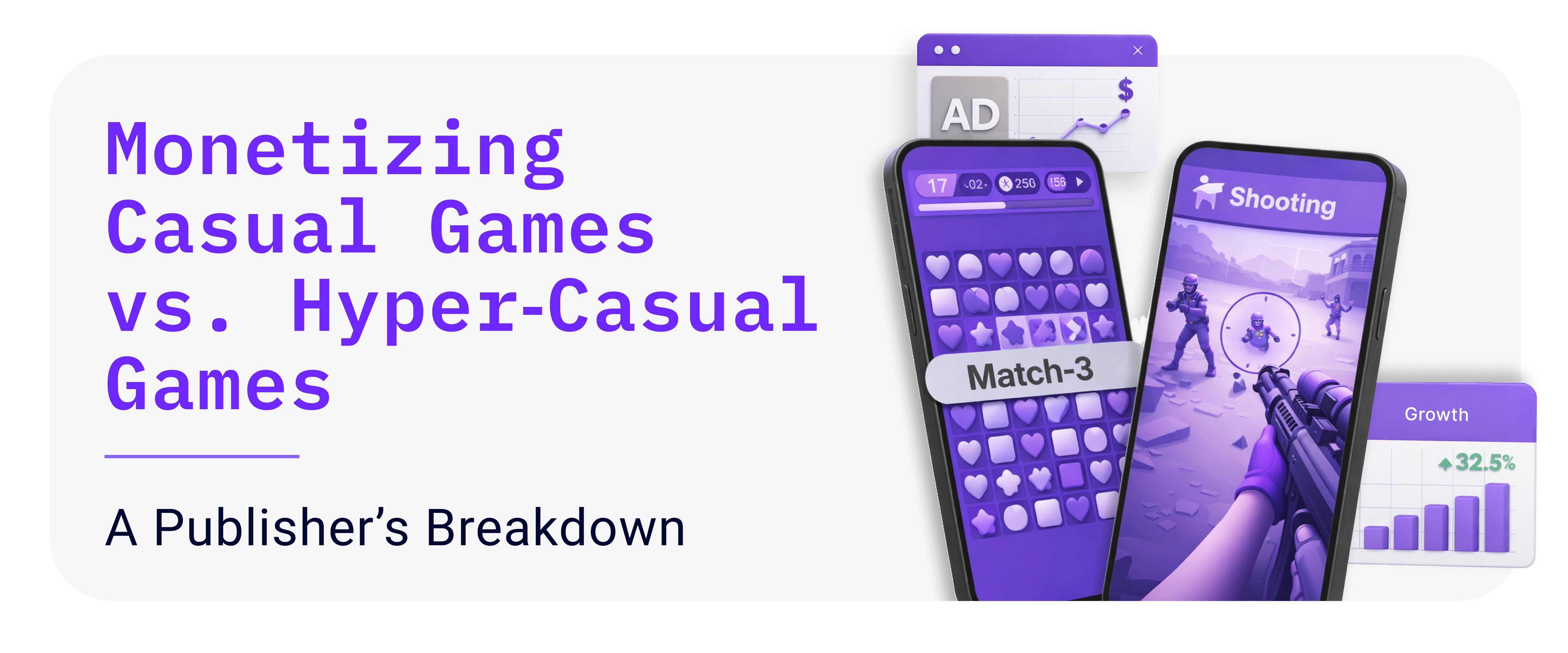
A game category can have titles that are both free-to-play and ad-supported but still need completely different monetization logic. That is because the player relationship is different: session shape, churn speed, and tolerance for interruption do not behave the same in casual and hyper-casual.
In 2026, the fastest way to damage performance is to apply one playbook to both.
1) The core difference is not “genre.” It is user lifecycle.
Hyper-casual games optimize for instant engagement. Sessions are short. Churn is fast. The monetization window per user is narrow.
Casual games are built around progression. Players invest time. Habit formation matters. The monetization window is longer, but it is also easier to destroy early if ad pressure is too aggressive.
That one difference drives everything: pacing, formats, and where you can safely interrupt.
2) Hyper-casual: monetize inside short sessions without killing the loop
Hyper-casual monetization works best when ads align with the rhythm players already accept end of a round, a failure state, a clear transition.
Interstitials often fit because they sit naturally between attempts. The mistake is trying to “add more” by interrupting active play. In hyper-casual, any friction that slows the next attempt is expensive because the loop is the product.
The goal is not maximum ad exposure. The goal is to monetize breaks without extending them.
3) Casual: protect progression, then scale ad pressure
Casual players come back because progression creates a reason to return. That means early experience sets the tone.
Rewarded ads are a strong fit because the player opts in and the ad moment can be attached to progression value. It is not just less disruptive. It is easier to place without breaking flow.
App open moments can also be high-quality because they monetize re-entry rather than interrupt gameplay. Done well, they capture value at a moment where the player is already switching contexts.
4) Format choice should follow “permission moments”
Across both categories, the best placements are the ones that feel earned:
- hyper-casual permission moments tend to be frequent and short
- casual permission moments tend to be tied to progression, re-entry, or deliberate opt-in
This is why copying a casual rewarded-heavy setup into hyper-casual can leave money on the table early, and copying a hyper-casual interstitial-heavy setup into casual can damage retention before habits form.
5) What both categories have in common
Two principles hold across both:
- Ads placed at natural breaks outperform ads that interrupt flow.
- Viewability and stability are baseline requirements. If placements are not consistently viewable or they create UI disruption, format strategy becomes harder to scale in either category.
Where YieldSolutions Fits
Getting monetization right across game categories is not just about picking the right format. It is about having the infrastructure to execute it precisely: the right bid dynamics, the right refresh behavior, and placements that are tuned to how players move through your game.
YieldSolutions works with app publishers to build ad setups that match their game loop, not work against it. Whether you are running a hyper-casual title where every second of session time counts, or a casual game where early retention is non-negotiable, we help you find and protect the moments that converts without the trial-and-error.
Ready to build an ad setup that fits your game loop? Get in touch with YieldSolutions and find out how the right monetization infrastructure can improve revenue without costing you retention.
